By Raja Safari Holidays – April 2026 -12 min read
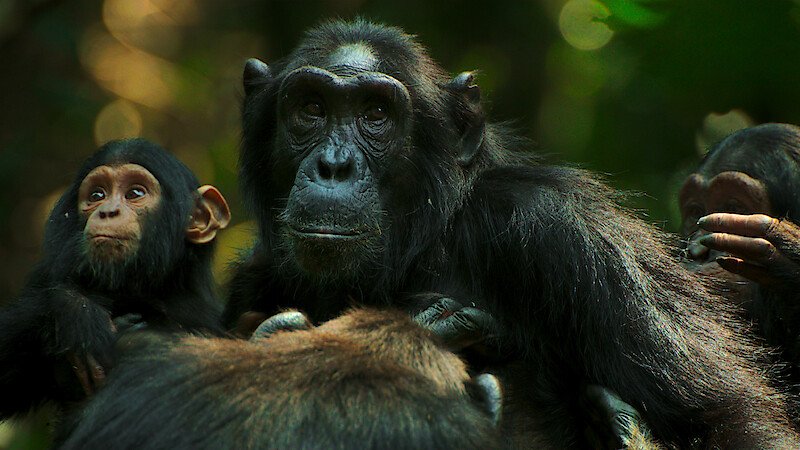
Deep inside the cathedral-green forests of Kibale National Park, something extraordinary is unfolding, something no human being has witnessed in recorded history. Uganda’s chimpanzees are at war with each other. Not with outsiders. With their own.
And it is one of the most profound windows into nature and into ourselves that science has ever opened.
The headlines have circled the globe this week. But what the headlines don’t tell you is this: you can go there. You can walk into that forest. You can sit within metres of the very species that has just rewritten everything we thought we knew about conflict, community, and what it means to belong.
This is your once-in-a-lifetime moment. And it is happening right now, in 2026, in Uganda.
A Community Torn Apart: The Story Behind the Headlines
For twenty years, roughly 200 chimpanzees lived together in the Ngogo forest as a single, thriving family. They groomed each other. Raised their young side by side. Patrolled the same boundaries. Shared the same ancient trees.
Then, quietly at first, something changed.
By 2015, two clusters had begun to form within the community, called the Western and the Central. Old friendships cooled. The males who had bridged the two sides began to disappear, taken by illness. A new alpha rose, and with him came tension no one could fully explain.
By 2018, the lines were drawn. Former companions became enemies. And the violence that followed has shaken the world of science.
A landmark study published in the journal Science on 9 April 2026 has confirmed what researchers at Kibale had been watching for years: this is a chimpanzee civil war — only the second ever observed in history, and the most documented, the most revealing, and the most heartbreaking.
Geneticists estimate that a permanent group split among chimpanzees happens, on average, once every 500 years. The last one observed was at Gombe, Tanzania, in the 1970s, and even then, the data was incomplete. What is happening at Kibale right now is the clearest, most scientifically rigorous window into this phenomenon that humanity has ever had.
The Science That Stopped the World
The research, led by evolutionary anthropologist Dr Aaron Sandel and his team, draws on nearly three decades of continuous observation at Kibale as reported by Scientific American. This is the second major conflict between chimpanzees observed in primatology, after the Gombe Chimpanzee War of the 1970s documented by Jane Goodall in Tanzania. It is meticulous. It is unprecedented. And its conclusions are humbling.
The Western faction, originally the smaller group, has waged a relentless campaign. By 2026, at least 28 chimpanzees will have been killed, including 19 infants. Mothers have had babies torn from their arms. Healthy males have vanished; their bodies never recovered. The Western group has grown from 76 to 108 individuals. The Central group has dwindled with every passing season.
Senior researcher John Mitani, who has spent two decades studying these animals, says with quiet devastation: “I think we’re witnessing an extinction event.”
But here is what makes this discovery so extraordinary and so deeply human:
There is no ethnic difference between the Western and Central chimps. No religious divide. No political ideology. These are not strangers. They are former friends, former grooming partners, former playmates who once shared the same shade in the same forest on the same afternoon.
The conflict did not arise from hatred of the “other.” It arose from the unravelling of the bonds between them.
The researchers believe it is the relational breakdown, the slow erosion of the social ties that once held the community together, that sparked everything. Which leads to a conclusion that should make every human being pause:
“Relational dynamics may play a larger causal role in human conflict than often assumed,” write Sandel and colleagues. “In some cases, it may be in the small, daily acts of reconciliation and reunion between individuals that we find opportunities for peace.”
We share 98.7% of our DNA with chimpanzees. When they show us who they are, they are, whether we like it or not, showing us something about who we are, too.
Why 2026 Is the Year to Go: A Once-in-500-Years Moment
Let that number sit with you for a moment. Once every 500 years.
The last time a chimpanzee community split and turned on itself, Jane Goodall was a young scientist crouched in the Tanzanian undergrowth, and the world had never heard of primatology. She watched it happen and barely believed what she was seeing. When she wrote about it years later, some colleagues doubted whether it was truly a natural event.
Now, in Kibale, with thirty years of baseline data, remote cameras, GPS collars, and a full research team, there are no doubts. This is real. This is natural. And this is happening right now, in a forest you can fly into from Entebbe in under six hours.
The scientists who have dedicated their careers to Kibale will spend the next decade writing papers about what is unfolding in these years. Documentaries will be made. Books will be written. School children in 2050 will study the Ngogo Civil War the way we once studied Gombe.
And in 2026, you can be there.
Not at the research site, the Ngogo community is deep in the forest interior and inaccessible to tourists, which also means the conflict poses absolutely no risk to visitors. But in the same park. Walking the same red-earth paths. Breathing the same moist, fig-scented air. And sitting, in profound silence, just metres from chimpanzees who carry within them the same evolutionary story.
What a Kibale Chimpanzee Trek Actually Feels Like
No description quite prepares you for the moment it happens.
You have been walking for perhaps forty minutes through the forest with your guide past towering strangler figs, over roots that arch like cathedral buttresses, through shafts of green light that fall from a canopy thirty metres above. You have been listening. And then your guide stops, raises a hand, and points.
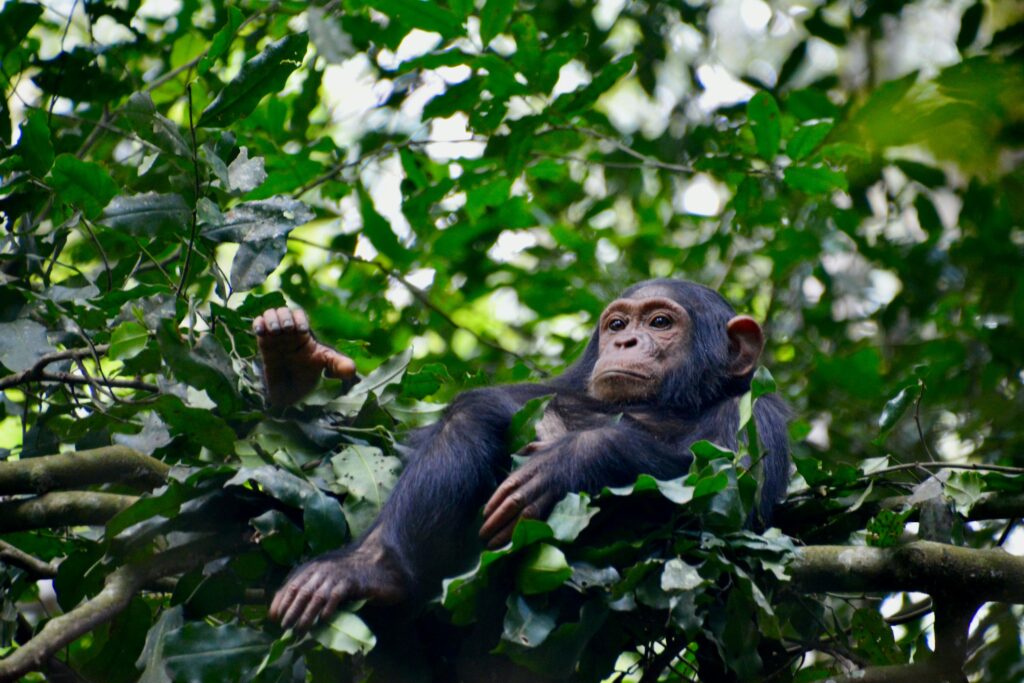
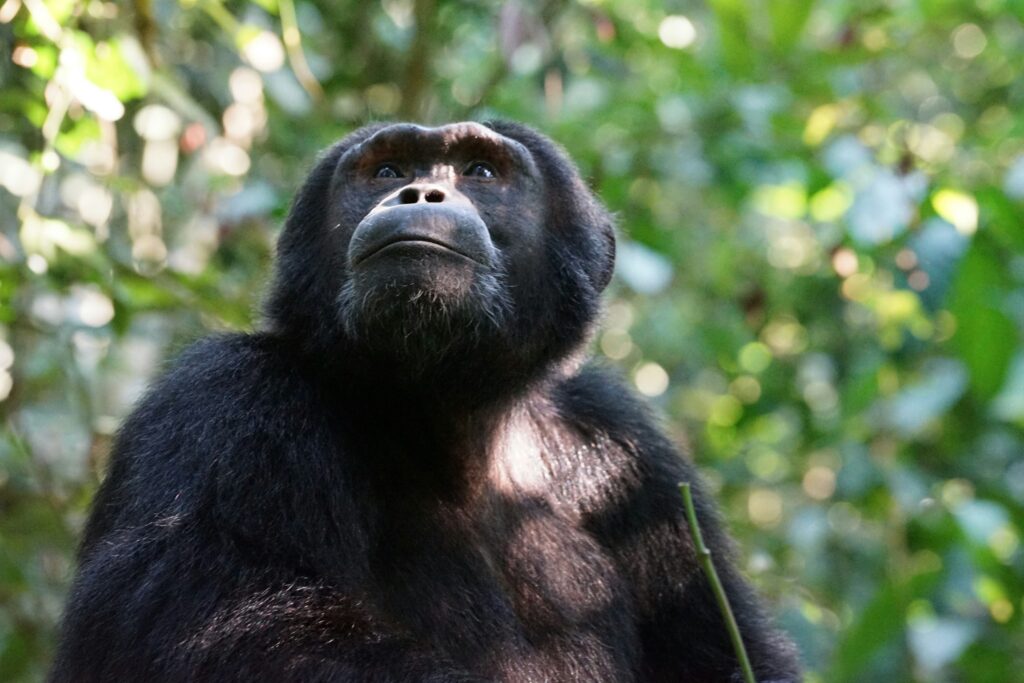
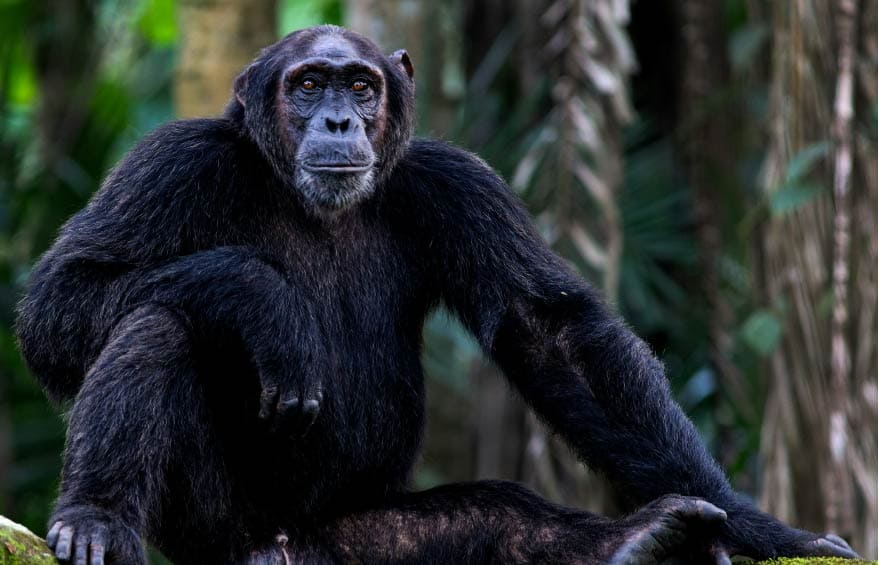
There, perhaps eight metres away, a large male chimpanzee sits on a low branch and looks at you. Not through you. Not past you. At you. With the same frank, evaluating gaze you might get from a stranger on a train who is trying to work out who you are.
The sound is followed by a low, rolling chorus of hoots from somewhere deeper in the forest as the rest of the group begins to move. Your guide whispers the male’s name. He has a name because the researchers have known him for years. He has a history. A personality. Possibly a grudge or two.
You stay for one hour. That is the rule strictly enforced to protect the animals’ well-being. But in that hour, you will see things that rearrange something inside you. A mother pulling her infant close. Two males grooming each other in a patch of sunlight, their movements slow and deliberate and intimate. The sudden explosive charge of a younger male who is having a bad morning.
You will come out of the forest different from how you went in.
Kibale National Park: Everything You Need to Know Before You Go
Where is Kibale National Park?
Kibale National Park is located in western Uganda, approximately 360 km from Kampala. The nearest town is Fort Portal, a charming highland town often used as a base for Kibale visits. The park covers 795 sq km of tropical rainforest and is widely considered the primate capital of the world, home to 13 primate species, including red colobus monkeys, grey-cheeked mangabeys, olive baboons, and, of course, the famous East African chimpanzees.
How Do You Get There?
From Kampala or Entebbe, you can reach Kibale by road in approximately 5–6 hours, passing through the scenic Rift Valley escarpment with views over Lake George. Alternatively, domestic charter flights to Kasese airstrip put you just 30 minutes from the park. At Raja Safari Holidays, we handle all transfers as part of our packages. Your journey begins the moment we pick you up.
When Is the Best Time to Visit Kibale for Chimpanzee Trekking?
Chimpanzee trekking in Kibale is possible year-round, but the two dry seasons offer the best conditions:
- June to August — the long dry season. Trails are firm, the forest is easier to navigate, and chimps tend to range lower where viewing is clearer.
- December to February — the short dry season. Fewer visitors, lush post-rain vegetation, and some of the most beautiful light in the forest.
The wet seasons (March–May and September–November) are not off-limits; in fact, serious wildlife photographers often prefer them for the dramatic skies and vivid greens, but trails can be muddy and treks more physically demanding.
How Long Is a Chimpanzee Trek?
Treks typically last 2 to 4 hours once you enter the forest, plus a 30–60 minute walk to find the group. You spend a guaranteed one hour with the chimpanzees once located. The entire experience, door to door, is usually a half-day activity — leaving your mornings or afternoons free for other experiences in the park.
For the most immersive experience, ask us about the Chimpanzee Habituation Experience (CHEX), a full-day activity where you join researchers in the forest from dawn to dusk, observing chimpanzees before they are fully habituated to human presence. This is as close to what the scientists at Ngogo experience as a visitor can get.
How Much Does a Chimpanzee Trekking Permit Cost?
Permits for standard chimpanzee trekking in Kibale are USD 250 per person for foreign non-residents. The CHEX permit is USD 300. Permits must be booked in advance, especially in peak season; availability is limited. Raja Safari Holidays handles all permit bookings on your behalf as part of your package.
Is It Safe to Visit Kibale Given the Chimpanzee Civil War?
Yes, completely. This is the question we have been receiving most since the news broke, and we want to answer it clearly and honestly.
The conflict is entirely confined to the Ngogo research community, which lives in the deep interior of the park, far from any tourist trekking areas. The communities’ visitors, who encounter Kanyawara and Kanyanchu primarily, are geographically separate, have their own stable social structures, and are entirely unaffected by events at Ngogo. They have been welcoming visitors for decades.
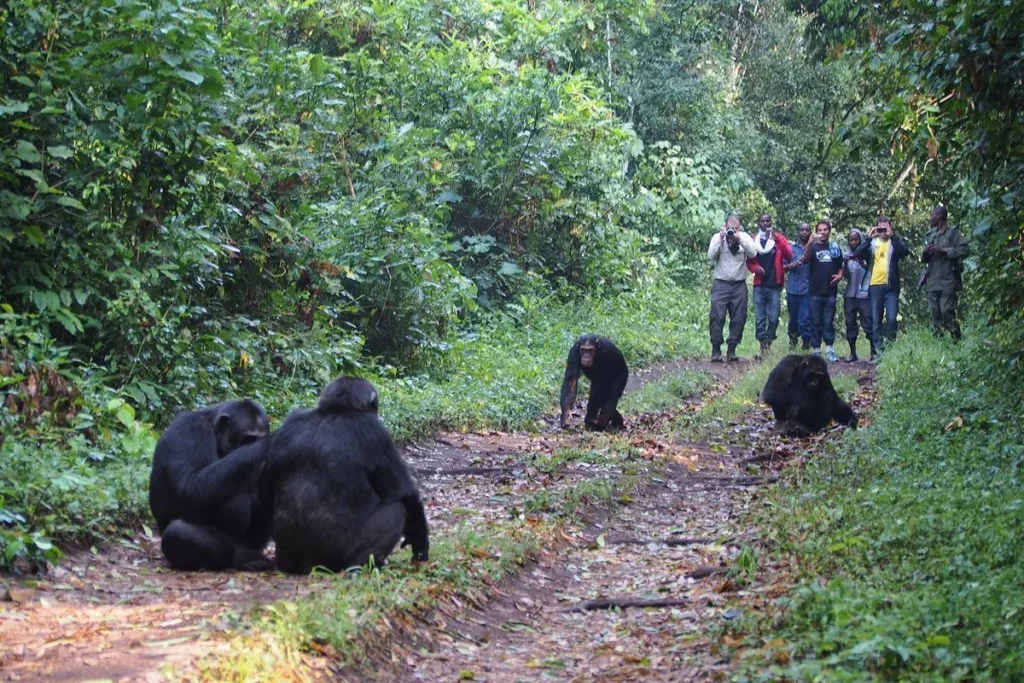
Every trek is led by experienced Uganda Wildlife Authority rangers who accompany your group throughout. You observe chimpanzees from a minimum distance of 8 metres. You will not encounter aggression. The only thing you are at risk of is having your entire worldview quietly rearranged.
Beyond Kibale: The Uganda Safari That Changes Everything
One of Uganda’s greatest and most underappreciated secrets is this: it is the only country on earth where you can trek both wild chimpanzees and mountain gorillas in a single trip.
Mountain Gorilla Trekking in Bwindi Impenetrable Forest
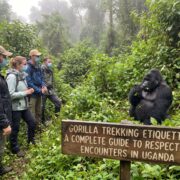
Just a few hours south of Kibale lies Bwindi Impenetrable National Park a UNESCO World Heritage Site and home to almost half of the world’s remaining mountain gorilla population. With fewer than 1,100 mountain gorillas left on earth, a permit to trek them is one of the most precious tickets in wildlife travel.
The experience is different from that of chimpanzees in every way. Gorillas are vast, unhurried, ancient-feeling. Where chimps are electric and unpredictable, gorillas have a gravitational stillness. Sitting with a silverback while his family grazes around him, infants tumbling over each other, females pulling at branches with enormous, gentle hands, is one of the few experiences in travel that is genuinely impossible to overstate.
Combine Kibale and Bwindi, and you have the most extraordinary primate journey on the planet.
Queen Elizabeth National Park
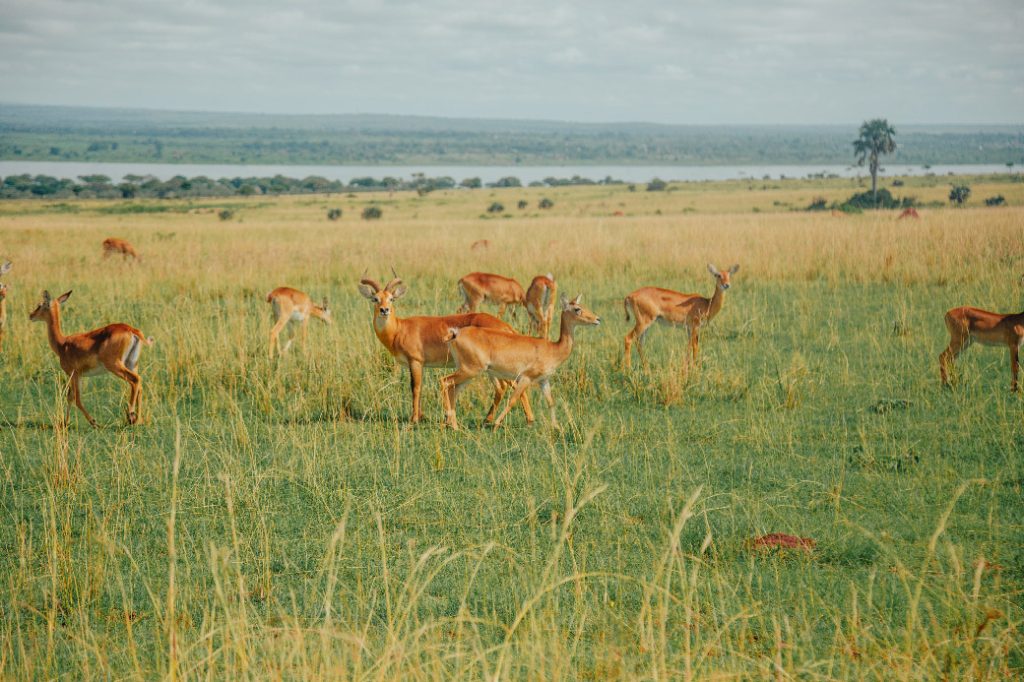
En route between Kibale and Bwindi, Queen Elizabeth National Park offers classic East African savannah lions, elephants, hippos, and the famous tree-climbing lions of the Ishasha sector. A sunset boat cruise along the Kazinga Channel, where hundreds of hippos and buffalo gather at the water’s edge, is one of Uganda’s signature experiences.
The Source of the Nile, Jinja
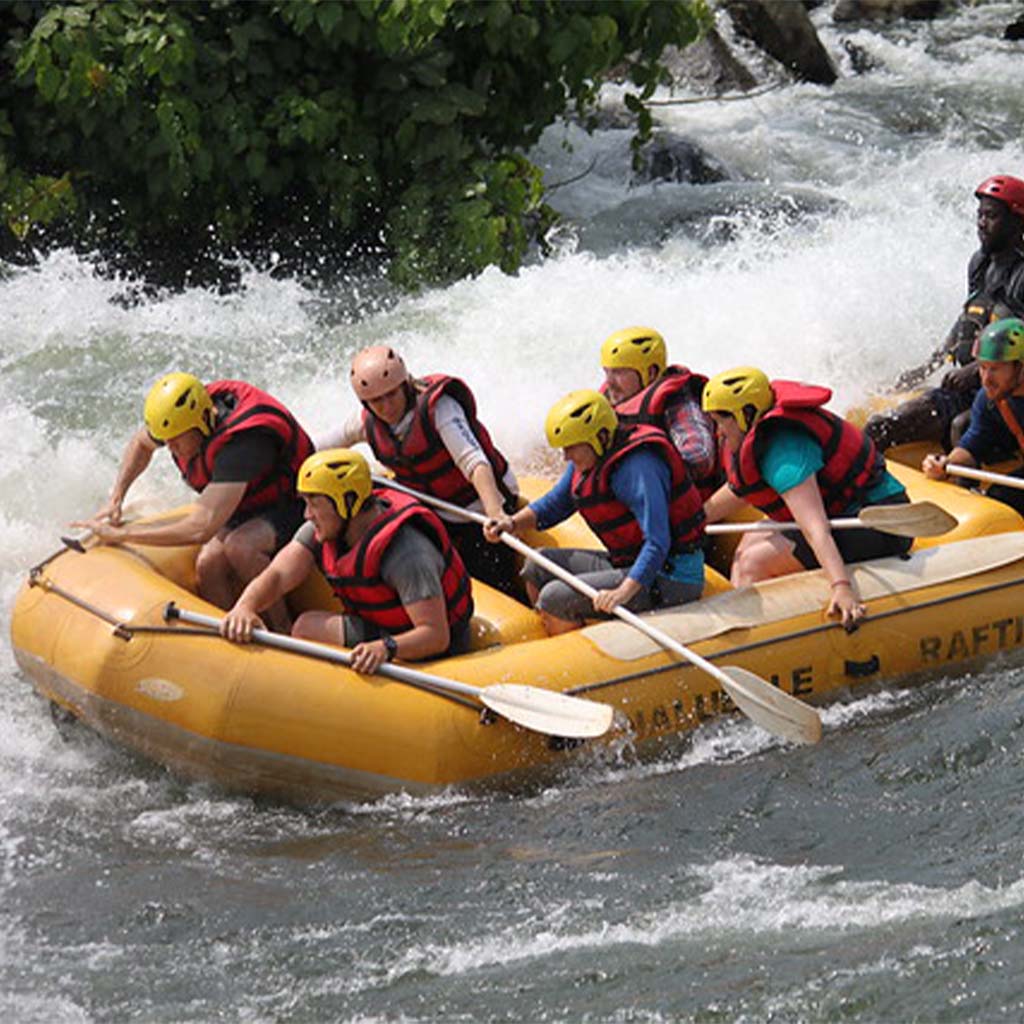
If you are travelling from Entebbe, a stop in Jinja, where the Nile begins its 6,650 km journey to the Mediterranean, adds a dimension to your trip that no other country can offer. White-water rafting, kayaking, or simply standing on the bank and contemplating the enormity of what you are looking at.
Why Uganda, Not Kenya or Tanzania?
Kenya and Tanzania are magnificent. No one is arguing otherwise. But Uganda offers something those destinations increasingly cannot: wildness without the crowds.
Kibale does not have the footfall of the Masai Mara. Bwindi does not have the queues of the Serengeti. You come here, and you feel, genuinely, that you are somewhere few people have been. The forest is sharing something with you privately.
And in 2026, with the eyes of the scientific world turned toward Uganda’s chimpanzees, there has never been a better time to understand why this small, green, profoundly alive country belongs on every serious traveller’s list.
Uganda Has Always Been This: Alive, Surprising, Unforgettable
Uganda is not merely a destination. It is a feeling.
It is the mist over Bwindi at dawn, where mountain gorillas move like shadows through ancient trees. It is the red-cheeked children waving from red-dust roads as your vehicle passes through terraced hillside villages. It is the Nile surging white and enormous through Jinja, and the silence of Queen Elizabeth National Park under a copper sky at dusk.
It is the moment a chimpanzee looks at you from eight metres away, and you realise, with a certainty that bypasses intellect entirely, that you are not separate from this. That you are part of the same long story.
And now, in 2026, it is also this: the place where humanity’s closest relatives have reminded us that peace is not a given, that it must be tended, daily, in the small acts of connection we choose to make and keep.
That is a lesson worth travelling for.
Frequently Asked Questions About Chimpanzee Trekking in Uganda
Do I need to be physically fit to trek chimpanzees in Kibale? A moderate level of fitness is recommended. Treks involve walking on forest trails for 2–4 hours, sometimes on uneven or muddy ground. Most healthy adults of any age manage comfortably. If you have mobility concerns, speak to us. We can advise on the most accessible options.
What should I wear and bring? Long-sleeved shirts and long trousers (to protect against insects and nettles), sturdy waterproof hiking boots, a light rain jacket, insect repellent, sunscreen, and a camera with a good zoom lens. Leave strong perfumes at the lodge; chimps are sensitive to unfamiliar smells.
Can children go chimpanzee trekking? Children aged 12 and above are permitted to trek with chimpanzees in Kibale. For families with younger children, we can arrange forest walks and other wildlife activities that are equally memorable.
How many people are allowed per trek? Groups are limited to 6 people per chimpanzee community per session to minimise stress on the animals. This small group size also means your experience is intimate and unhurried.
How far in advance should I book? We recommend booking at least 3–6 months in advance, especially for peak season travel (June–August and December–February). Gorilla permits in Bwindi are even more limited and should be secured as early as possible.
Can I combine chimpanzee and gorilla trekking in one trip? Absolutely, and we strongly recommend it. Our signature Uganda Primates Safari combines Kibale chimpanzee trekking, Bwindi gorilla trekking, and Queen Elizabeth National Park in 7–10 days. Contact us for a tailored itinerary.
Begin Your Journey With Raja Safari Holidays
At Raja Safari Holidays, we have been bringing travellers into Uganda’s heart for years. We know these forests. We know these communities. We know the guides, the rangers, the lodges, and the hidden corners of the park that make the difference between a good trip and an unforgettable one.
We are a fully licensed Ugandan tour operator. Every booking we take directly supports local guides, conservation levies, and the communities living alongside these extraordinary parks.
The chimpanzees of Kibale are making history. In 500 years, when the next group splits, someone will write about this moment in this window in the early 2020s when the rarest event in primate behaviour played out in real time, and the world watched.
You do not have to watch from far away.
Contact our team at Raja Safari Holidays to begin planning your Uganda safari.
Explore our Kibale Chimpanzee Trekking packages and witness the forest that has just changed science forever.
View our combined Primates Safari — Chimps + Gorillas, the ultimate Uganda wildlife experience.
Sources: Sandel, A.A. et al. (2026). “Lethal conflict after group fission in wild chimpanzees.” Science, 392, 216. | Scientific American | Live Science | NBC News | Uganda Wildlife Authority | Visit Uganda
Raja Safari Holidays is a licensed Ugandan tour operator committed to responsible, conservation-positive travel.